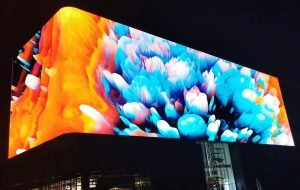
Ultra-fine pitch LED displays are moving beyond specialist installations into a wider range of professional display environments. Corporate boardrooms, broadcast studios, control rooms and premium commercial spaces increasingly require large-format images that remain sharp at close viewing distances. At the same time, improvements in LED packaging and manufacturing are making pixel pitches below 1.0 mm more practical than they were just a few years ago.
The shift is not simply about achieving a higher resolution. Buyers are reconsidering how displays fit into their spaces, how information is presented, and how much value a seamless screen can deliver over its service life.
For manufacturers and integrators, the central question is no longer whether ultra-fine pitch technology is possible. It is where the additional pixel density creates a meaningful improvement, and which technologies can deliver that improvement reliably.
The Move Toward Closer Viewing and More Detailed Content
One of the strongest drivers of demand for a fine pitch LED display is the changing nature of on-screen content.
Traditional large-format displays often focused on video, presentations and general visual communication. Modern professional environments increasingly require viewers to read small text, examine detailed graphics, compare multiple data feeds and interact with complex digital content. Pixel visibility becomes much more noticeable when the audience sits close to the screen.
A P2.5 display may perform well in a large auditorium, where viewers are several meters away. In a boardroom where participants sit close to the wall, however, the same pixel pitch may reveal visible pixel structure around text and fine lines. Moving to P1.2, P0.9 or a smaller pitch can produce a more continuous image.
This is particularly relevant to:
- Corporate meeting rooms: Detailed presentations, spreadsheets and video conferencing benefit from a higher pixel density.
- Control rooms and command centers: Operators need to interpret dashboards, maps and multiple information sources throughout the day.
- Broadcast studios: Fine image detail, consistent color and camera-compatible display performance are essential.
- Premium retail and hospitality: Close-up viewing makes image uniformity and surface quality more noticeable.
- Education and visualization: Detailed diagrams, technical models and large digital canvases benefit from improved clarity.
The correct pixel pitch still depends on the closest viewing distance, screen dimensions and content. A smaller pitch is valuable when the audience can actually see the difference—not simply because the specification looks more advanced.
Seamless Imaging Is Becoming a Competitive Advantage
LCD video walls remain a practical option for many installations, but the physical bezels between panels can interrupt content across the display surface. These dividing lines become particularly distracting when a presentation spans multiple screens or when operators need to interpret information distributed across a large visual canvas.
A direct view LED (dvLED) video wall takes a different approach. Each LED cabinet contributes to a continuous image, without the conventional panel borders associated with tiled LCD displays.
For applications that display maps, financial data, video feeds or full-screen brand content, this seamless presentation can improve the overall viewing experience. It also gives designers greater freedom to build displays in custom dimensions rather than being restricted to a fixed LCD panel arrangement.
Ultra-fine pitch strengthens this advantage. When the audience sits close to a large dvLED video wall, the combination of seamless construction and dense pixel spacing helps preserve image detail across the entire surface.
However, the comparison should include more than visible bezels. Project cost, installation space, brightness, maintenance access, operating conditions and expected service life all influence whether LED or LCD is the better choice.
COB and MIP Are Expanding the Technical Possibilities
The development of ultra-fine pitch displays depends heavily on how LED chips are packaged and protected.
As pixel pitch decreases, the physical space available for each pixel becomes smaller. Manufacturers must maintain precise chip placement, consistent color output, reliable electrical connections and acceptable production yields within increasingly compact structures.
Two technologies receiving particular attention are Chip on Board (COB) and Micro LED in Package (MIP).
COB technology mounts LED chips directly onto a substrate and protects the emitting surface with a common encapsulation layer. Depending on the design, this construction can improve resistance to dust, accidental contact and other forms of physical damage. It can also support high contrast and a more uniform display surface.
These characteristics make COB attractive for fine pitch LED displays in control rooms, executive spaces and other professional environments where continuous operation and close viewing are important.
MIP technology uses packaged micro-LED components designed for fine-pitch applications. It offers another route to smaller pixels while allowing manufacturers to develop different approaches to component selection, repair and production.
Neither technology automatically guarantees better results. Image uniformity, black levels, low-gray performance, repair procedures and manufacturing consistency still depend on the complete product design.
Market data points to continued technical progress. Omdia reported that global shipments in the 0.60–0.99 mm pixel-pitch category increased 11.6% year over year in the first quarter of 2026, even as the overall LED video display market recorded a 2.3% decline in revenue. The figures suggest growing interest in sub-1 mm applications, although performance varies considerably by pixel-pitch segment and market.
Lower Costs Are Making Ultra-Fine Pitch More Accessible
For years, the main barrier to ultra-fine pitch LED adoption was cost. Smaller pixels require more LEDs per square meter, tighter manufacturing tolerances and more demanding quality-control procedures. The resulting price premium limited deployment to projects with particularly demanding image-quality requirements.
Manufacturing improvements are gradually changing that calculation.
Advances in LED packaging, driver ICs, production processes and calibration have expanded the range of available pixel pitches while improving consistency. As production experience grows, manufacturers can refine assembly processes and reduce defects that affect yield and overall project economics.
Industry forecasts have also identified fine-pitch indoor displays as an important area of LED video wall development. TrendForce’s 2025 market outlook highlighted demand from corporate and education environments, virtual production, home theaters and cinemas, alongside continued development of smaller-pitch products.
Nevertheless, falling component costs do not mean that every project should move to P0.7 or P0.9. A P1.2 or P1.5 display may already deliver the required visual performance at a significantly more attractive total cost.
The commercial opportunity lies in matching improved resolution with a genuine application need.
More Demanding Applications Require More Than High Resolution
Ultra-fine pitch increases image detail, but pixel pitch alone cannot determine the quality of a professional dvLED installation.
Control rooms, for example, may operate for extended hours with multiple information sources displayed simultaneously. In these environments, stable color reproduction, low-gray performance, thermal management and consistent brightness are essential. Front-service access can also make a substantial difference when maintenance must be completed without dismantling the installation.
Broadcast studios introduce another challenge: camera performance. Refresh rate, grayscale processing, scan configuration and camera settings can affect how the display appears on video. A screen that looks excellent to the naked eye may still produce unwanted artifacts when filmed.
Corporate boardrooms place greater emphasis on readable text, natural skin tones and a comfortable viewing experience. Premium retail installations may prioritize color consistency, contrast and the ability to integrate a large display into the surrounding architecture.
These differences explain why an ultra-fine pitch LED display should be specified as part of a complete system. The receiving hardware, processing, calibration, cabinet construction and maintenance strategy all contribute to the result.
For integrators, evaluating a display with the intended content and viewing conditions is more useful than comparing headline specifications alone.
Energy Efficiency and Lifecycle Value Matter More as Pixel Density Increases
As LED displays become more sophisticated, buyers are paying closer attention to operating costs and long-term reliability.
High pixel density can increase the number of components installed per square meter, but power consumption is not determined by pixel pitch alone. LED efficiency, driving current, brightness settings, image content, processing architecture and power-management features all affect actual consumption.
The same applies to heat generation. An installation must dissipate heat effectively to maintain stable performance and avoid unnecessary stress on components.
For a dvLED video wall operating for many hours each day, even modest differences in energy use can accumulate over several years. Maintenance frequency, spare-module availability and the time required to restore a display after a fault also affect its total cost of ownership.
Procurement teams should therefore compare typical operating power alongside maximum power, ask how reliability is tested, and establish clear expectations for warranty coverage and spare parts.
A lower purchase price may be attractive initially, but a display that is difficult to maintain or inconsistent across modules can create additional costs after installation.
Where Is the Ultra-Fine Pitch Market Heading?
The next phase of development is likely to combine smaller pixel pitches with improvements in manufacturing maturity, image processing, energy management and serviceability.
Sub-1 mm displays will remain relevant to applications where viewers sit close to the screen or need to interpret detailed information. COB and MIP will continue to shape product development, while improvements in calibration and production consistency will influence how confidently integrators can deploy these systems at scale.
At the same time, the market will remain segmented. Large venues, auditoriums and many commercial signage projects do not necessarily benefit from ultra-fine pitch. Their viewing distances and content requirements may be served more economically by P1.8, P2.5 or larger pixel pitches.
For Cinstar Display and other manufacturers serving professional LED projects, the opportunity is to help integrators identify the right balance between image quality, installation requirements and lifecycle cost. That means treating pixel pitch as one part of the specification rather than the sole measure of product quality.
Conclusion
Demand for ultra-fine pitch LED displays is being driven by several connected changes: closer viewing distances, more information-intensive content, the preference for seamless large-format imaging, advances in COB and MIP packaging, and improving production economics.
These developments are expanding the role of direct view LED technology across corporate, broadcast, control-room and premium commercial applications. Yet the smallest available pixel pitch is not automatically the best investment.
A successful dvLED video wall must deliver the resolution the audience needs, maintain consistent image quality, fit the physical environment and remain practical to operate over time. As the technology matures, those complete-system considerations—not pixel pitch alone—will determine which solutions deliver lasting value.